

Domains
Register a domain
Reseller Hosting
Your Own Hosting Business
Wordpress Hosting
Managed WordPress Hosting

Windows VPS
Automated updates and plugins
Linux VPS
Lightning-fast with 100% uptime SLA
OpenClaw VPS
Host Your OpenClaw Agent on VPS
Hermes Ai VPS
Host Your Hermes Agent on VPS
VPS Locations
Choose from global server locations
What Is Hermes Agent and How Can It Help Your Business?
By Siraj, Hosting Engineer at Neteronhost Published: May 2026 | Last Updated: May 2026
TL;DR
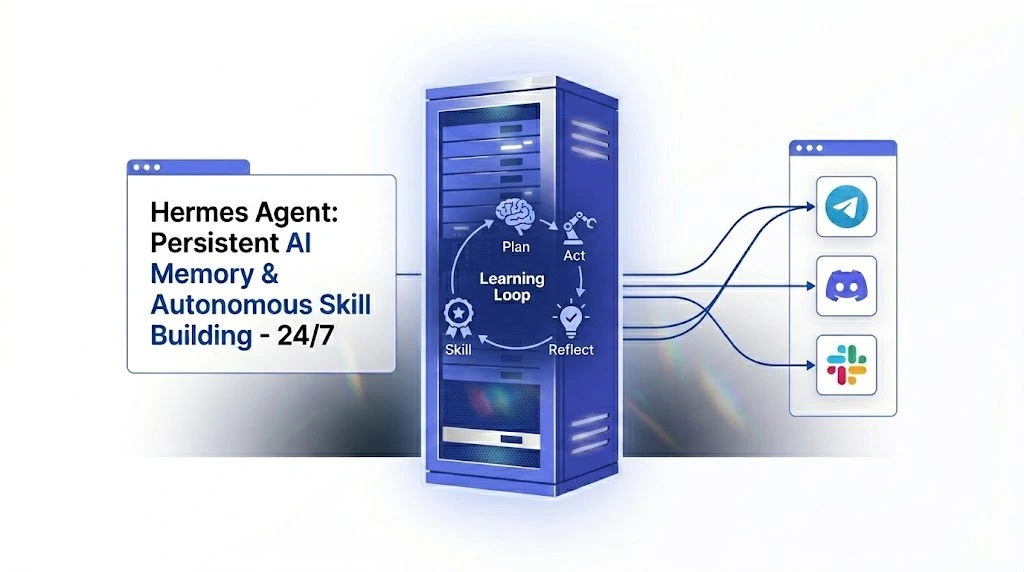
Hermes Agent is an open-source autonomous AI agent built by Nous Research. Unlike a chatbot, it runs continuously on a server, builds a persistent memory of your work and preferences, creates reusable skills from experience, and connects to Telegram, Slack, WhatsApp, Discord, and 15 more platforms. The longer it runs, the more useful it gets. Businesses use it for SDR research, competitor monitoring, inbox management, and overnight task execution. You need a VPS to run it.
Introduction
Most AI tools solve one problem well and forget everything when you close the tab. You ask ChatGPT a question, get a good answer, and start from zero the next time. For personal use, that is fine. For a business trying to automate real workflows, it is a fundamental limitation.
Hermes Agent works differently. It is an open-source autonomous agent built by Nous Research, the lab that created the Hermes 3 language model. Hermes runs on a server around the clock, builds memory across every session, learns from the tasks it completes, and connects to the tools your team already uses. This guide explains what Hermes Agent is, how it works, and where it actually helps a business.
Running Hermes Agent requires a always-on server. See NeteronHost Hermes AI VPS plans from $14.99/mo.
What Is Hermes Agent?
Hermes Agent is an autonomous AI agent. The word “autonomous” is doing real work in that sentence. A standard AI assistant waits for your input, generates a response, and stops. Hermes takes a task, breaks it into steps, executes those steps using real tools, handles errors on its own, and delivers a result, without you staying involved.
It runs as a persistent process on a server. That means it is active 24 hours a day, not just when you open a browser tab. You can assign it a task at midnight, go to sleep, and find the completed output in your Telegram chat by morning.
Hermes connects to external platforms through a single gateway. You configure it once to connect to your email, Slack, GitHub, Notion, or CRM. From that point, your agent can read from and write to any of those platforms as part of a workflow, without you manually copying information between tools.
The project is open source under the MIT license, which means the code is publicly auditable and free to use. You host it yourself on your own server.
Who Built Hermes Agent?
Nous Research built Hermes Agent. Nous Research is an AI safety and capabilities research lab known primarily for the Hermes series of fine-tuned language models. Their Hermes 3 model, built on Meta’s LLaMA 3.1 architecture, became one of the most widely used open-source models for instruction following and agentic tasks in 2024 and 2025.
The Hermes Agent project is a practical application layer built on top of that model research. The same team that trained the model built the agent framework designed to run it. That lineage matters because the agent is optimized for the model it uses, rather than being a generic framework bolted onto whatever model happens to be popular.
Hermes Agent supports multiple model backends. While it is optimized for Nous models available through Nous Portal and OpenRouter, it also works with OpenAI, Anthropic, and custom API endpoints. You bring your own API key and pay the model provider directly, with no markup from the agent framework.
How Hermes Agent Is Different From ChatGPT
This comparison comes up constantly, so it is worth being specific about the differences rather than vague about “capabilities.”
ChatGPT is a conversation interface. Every session starts fresh. The model has no knowledge of your previous sessions, your preferences, your ongoing projects, or the tasks you ran last Tuesday. Some paid tiers include memory features, but they are limited summaries, not a full operational record.
Hermes Agent is a persistent operating environment. It maintains a complete memory of every conversation, task, decision, and outcome. When you assign it a task today that relates to work from two weeks ago, it retrieves that context automatically. It does not need you to re-explain your business, your ICP, your tone of voice, or your existing workflows.
ChatGPT executes within a conversation. It can use tools like web search and code interpreter during a session, but those tool uses are ephemeral. They do not result in reusable procedures.
Hermes Agent builds skills. When it completes a task, it has the option to save the approach as a reusable skill. The next time a similar task comes up, it executes the skill rather than solving the problem from scratch. Skills improve over time as the agent encounters variations and edge cases.
The practical outcome: a Hermes agent that has been running for 60 days is measurably more useful than one that started yesterday. A ChatGPT session is the same regardless of how long you have been a user.
| Feature | ChatGPT | Hermes Agent |
|---|---|---|
| Persistent memory | Limited (paid tiers only) | Full, across all sessions |
| Skill building | No | Yes, self-improving |
| Runs while you sleep | No | Yes, 24/7 on server |
| Platform integrations | Limited plugins | 20+ native integrations |
| Self-hosted | No | Yes, MIT license |
| Model flexibility | OpenAI only | Any API endpoint |
| Cost structure | Subscription | VPS cost plus API calls |
How Hermes Agent Memory Actually Works
Memory is the feature that separates Hermes from most other AI agent frameworks. It is worth understanding how it works in practice, not just in marketing terms.
Hermes uses a layered memory architecture. When you interact with the agent, it stores three types of information.
Episodic memory captures what happened in specific interactions. The task you assigned, the approach the agent took, the result, and any feedback you gave. This is the raw record of the agent’s history with you.
Semantic memory captures facts, preferences, and knowledge that the agent extracts from episodic memory over time. Your company name, your ICP, your writing tone, your preferred tools, your recurring workflows. This is what allows the agent to operate with context without you re-explaining everything.
Procedural memory is the skill library. When the agent completes a complex task successfully, it can save the procedure as a reusable script. Subsequent similar tasks run faster and more reliably because the agent is executing a tested procedure rather than reasoning through the problem again.
All three memory types are stored on your server. They persist through restarts, updates, and new sessions. This is why running Hermes on a dedicated VPS matters: if your server goes down frequently or restarts without warning, memory writes can corrupt. A reliable server with 99.99% uptime is a practical requirement, not a nice-to-have.
Keep your Hermes agent’s memory intact. Deploy a Neteronhost Hermes AI VPS with 99.99% uptime
What Hermes Agent Can Do for Your Business
The use cases below are based on documented Hermes agent deployments and community reports from r/HermesAgent and the Nous Research Discord.
Inbox and Calendar Management
Hermes connects to Gmail or any IMAP-compatible email account. It can triage incoming email by priority, draft replies in your voice using your communication history as reference, flag action items, and schedule follow-ups. For a founder getting 200+ emails a day, having an agent handle triage reduces the time spent on email from hours to minutes.
Overnight Research and Briefings
You assign Hermes a research task before leaving for the day. It uses web search tools, visits relevant pages, structures the findings, and delivers a formatted report to your Telegram or Slack by morning. The quality of the output improves as the agent learns your preferred report format and the sources you find credible.
Competitor Monitoring
Hermes runs scheduled monitoring tasks. It checks competitor websites, pricing pages, job boards, and social profiles at whatever interval you set, typically daily or weekly. When it detects a meaningful change, it alerts you with a summary. This is a task that would otherwise require either a dedicated employee or a paid monitoring tool costing $200 to $500 per month.
Meeting Preparation
Before any meeting on your calendar, Hermes can research the attendees, pull relevant context from your previous interactions with them, summarize recent news about their company, and prepare a briefing. The agent does this automatically when it sees a new calendar event with external attendees.
Code Review and CI Monitoring
For development teams, Hermes connects to GitHub and monitors pull requests, CI pipelines, and issue trackers. It can review PRs for common issues, investigate failing tests, draft fix suggestions, and notify the relevant team member through Slack. This does not replace a senior engineer’s review. It handles the mechanical first pass so that human review time focuses on architecture and logic rather than formatting and obvious bugs.
Hermes AI SDR: Automating Sales Research
Sales development is one of the highest-ROI use cases for Hermes Agent, and the one most commonly discussed in the sales community. The term “Hermes AI SDR” refers to deploying Hermes as a sales development research assistant.
The bottleneck in most SDR workflows is not sending outreach. It is finding the specific, timely reason that makes a prospect worth contacting right now. A funding announcement. A new hire in a relevant role. A product launch that creates a problem your solution solves. Researching that context for 50 prospects manually takes 3 to 6 hours of a skilled SDR’s time every day.
Hermes automates the research layer. You give it your ICP, your value proposition, and a list of target accounts or a set of search criteria. It surfaces prospects that match, researches each one for a timely contact reason, and delivers a structured list with the research attached. The SDR reviews the output, selects the strongest hooks, and writes or approves the outreach.
According to reports from sales teams using AI-assisted research workflows, the research phase that previously occupied 40% to 60% of an SDR’s day can be reduced to under 30 minutes of review time. The SDR spends the rest of their time on the higher-value work: conversations, discovery calls, and relationship building.
Hermes AI SDR is not a sequence tool. It does not replace your outreach platform. It handles the research that makes your outreach worth reading.
What Hermes AI SDR does:
- Monitors LinkedIn for job changes at target accounts
- Tracks funding announcements, product launches, and press mentions
- Identifies the specific trigger that makes a prospect relevant right now
- Drafts personalized contact reasons based on that research
- Delivers a daily briefing of actionable prospects with context attached
What it does not replace: Human judgment on which prospects to prioritize, the actual relationship-building conversation, and final approval on outreach copy.
What You Need to Run Hermes Agent
Hermes Agent requires a server that runs continuously. A laptop will not work for any serious deployment because the agent needs to stay active to execute scheduled tasks, respond to incoming messages, and build memory reliably.
The minimum viable setup is a VPS with 2GB RAM. That handles a personal agent with light task loads. For SDR research workflows, competitor monitoring running on a daily schedule, or team deployments with multiple users, 4GB to 8GB RAM is more appropriate.
Server requirements:
| Use Case | RAM | Storage | OS |
|---|---|---|---|
| Personal agent, light tasks | 2GB | 25GB NVMe | Ubuntu 22.04 |
| SDR research, scheduled monitoring | 4GB | 50GB NVMe | Ubuntu 22.04 |
| Multiple concurrent agents | 8GB | 80GB NVMe | Ubuntu 22.04 |
| Team deployment, heavy automation | 16GB+ | 160GB+ NVMe | Ubuntu 22.04 |
NVMe SSD storage matters for Hermes specifically because the agent reads from and writes to its memory store constantly. On SATA SSD, those read/write operations add latency to every agent action. On NVMe SSD with read speeds up to 7,000 MB/s, memory retrieval is near-instant.
Neteronhost Hermes AI VPS plans come with Ubuntu 22.04 pre-installed, Hermes pre-configured, and DDoS protection up to 100Gbps included on every plan. Deployment takes under 60 seconds.
Hermes Agent vs Other AI Agents
The AI agent space has expanded rapidly in 2025 and 2026. Here is how Hermes compares to the most commonly mentioned alternatives.
Hermes vs AutoGPT: AutoGPT was one of the first widely publicized autonomous agent frameworks. It demonstrated the concept but was unreliable in production. Hermes is a more mature implementation with explicit memory architecture, skill building, and a stable gateway for platform integrations. AutoGPT development has slowed significantly since 2024.
Hermes vs Claude Projects: Claude Projects (Anthropic) offers memory within the Claude interface and can maintain context across conversations. It is not autonomous. It does not run tasks on a schedule, monitor external systems, or execute workflows without your involvement. Claude Projects is a better memory layer for a chat interface; Hermes is a better autonomous execution environment.
Hermes vs OpenClaw: OpenClaw and Hermes are both open-source autonomous agent frameworks with similar architectural goals. OpenClaw has a larger community and more third-party integrations. Hermes has tighter integration with Nous Research models and a more developed skill system. Many users run both. NeteronHost offers dedicated VPS plans for both: OpenClaw VPS and Hermes AI VPS.
Hermes vs n8n/Zapier: n8n and Zapier are workflow automation tools, not AI agents. They execute predefined logic between APIs. Hermes handles tasks that require judgment, research, summarization, and decision-making that cannot be reduced to if-this-then-that logic. They serve different purposes and are often used together.
Frequently Asked Questions
Hermes Agent is an AI that lives on your server, works around the clock, and remembers everything. You give it tasks through Telegram, Slack, or any supported platform. It executes them, stores the results in memory, and gets better at your specific workflows over time. Think of it as an AI employee who never clocks out and never forgets a conversation.
The Hermes Agent framework is open source and free under the MIT license. You need two things to run it: a server (a VPS starting around $14.99/month) and an API key for the model you want to use. Model costs depend on usage. For most personal and small business deployments, total monthly costs including the VPS run between $20 and $60.
The setup process requires basic familiarity with a Linux server and command line. It is not a one-click install. That said, NeteronHost Hermes AI VPS plans come with Hermes pre-configured. The setup wizard handles the core configuration and walks you through connecting your first messaging platform. No prior server administration experience is required beyond following the wizard steps.
Hermes AI refers to the agent framework overall. Hermes AI SDR refers specifically to using that framework for sales development research, prospect identification, and outreach personalization. SDR is a use case, not a separate product. The same Hermes agent that manages your inbox can also run SDR research workflows.
For specific, well-defined research and automation tasks, Hermes can handle work that would otherwise require part-time or full-time staff time. It cannot replace judgment-heavy roles, relationship management, or work that requires accountability and legal responsibility. The realistic framing is that Hermes handles the mechanical, repeatable parts of knowledge work so that human employees focus on the higher-value parts.
The agent is functional from day one. It becomes noticeably more useful after 2 to 4 weeks of regular use, as its memory of your preferences, workflows, and communication style builds up. Users in the Nous Research community report that agents running for 60 or more days produce output that requires significantly less review and correction than freshly deployed instances.
The agent stops executing tasks until the server comes back online. Scheduled tasks that were missed do not retroactively execute — they are skipped. Memory stored before the outage is preserved. For business-critical deployments, running on a VPS with a 99.99% uptime SLA (less than 52 minutes of downtime per year) is important. NeteronHost Hermes AI VPS plans include this SLA on every plan.
Premium VPS hosting, shared hosting, and cloud servers with NVMe SSD storage, dedicated IPs, and instant deployment. Powering businesses worldwide.
Copyright © 2026 Neteronhost. All Rights Reserved